
Peacock Feathers
The Pale Plume
White Peacock Feathers, and the Long History Behind a Rare Feather
Of all the materials that pass through a milliner's hands, few carry as much history — or as much myth — as the peacock feather. And of all peacock feathers, none is rarer or stranger than the white one: the plume of a leucistic bird, stripped of color but not of form. Before it ever reaches a hat block, that feather has already traveled through centuries of royal courts, religious symbolism, and superstition. Understanding that history is part of understanding why it still commands a room today.
A Feather Long Before It Was a Trend
The peacock feather has never been just decoration. In Hindu tradition, it is inseparable from Krishna, who is depicted wearing a peacock crown — the feather standing in for beauty, protection, and divine grace. In ancient Greek and Roman mythology, the "eyes" on the feather were said to be the hundred eyes of the giant Argus, placed there by the goddess Hera, linking the feather forever to watchfulness and immortality.
By the Byzantine and Persian courts, peacock feathers had become a shorthand for royalty itself — woven into thrones, fans, and ceremonial dress. Centuries later, in Qing dynasty China, an actual peacock feather affixed to a mandarin's hat denoted rank and imperial favor, awarded rather than purchased. A feather, in other words, has rarely just been a feather. It has been a rank, a blessing, a warning, and a crown.
Curiously, the feather also picked up a reputation for bad luck in parts of Victorian Britain — theatre folklore in particular held that the "eye" pattern invited misfortune onstage, a superstition some performers still observe today. That tension between glamour and omen is part of what makes the feather such rich material for a milliner: it has always meant more than one thing at once.
The White Exception
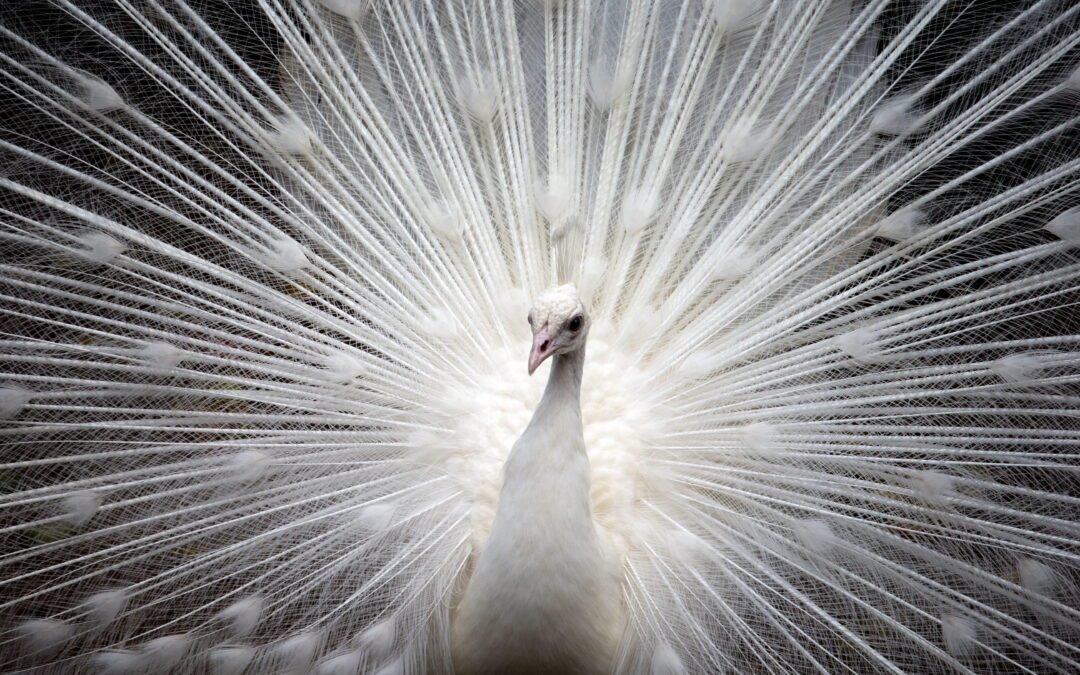
Set against that long, colorful history, the white peacock feather is something else entirely: an anomaly the bird itself didn't choose. Leucism — a genetic condition that suppresses pigment while leaving the feather's underlying structure intact — produces a bird rendered almost entirely in white, eyes and all, with the famous "eye" motif still faintly visible in the weave of the plume when the light catches it right.
Because true leucistic peafowl are uncommon, white plumes have historically carried their own mystique — often associated with purity, transcendence, and the otherworldly in a way standard iridescent feathers, for all their color, never quite achieved. Where a traditional peacock feather says opulence, a white one says something closer to reverence.
In the Milliner's Hands
For a couture milliner, the appeal of the white plume is structural as much as symbolic. Strip away the iridescence, and what remains has to work on shape alone — the curl of the frond, the architecture of the eye rendered in tone rather than color. That makes it a favorite for bridal work and for monochrome or minimalist pieces, where a feather needs to read as elegant rather than showy.
Milliners will curl, trim, or strip the barbs down to the quill depending on the effect they're after: a single dramatic sword feather swept off a brim for drama, or a cluster of softer wisps worked into the crown for texture. Set against black felt or veiling, a white plume becomes a study in restraint — proof that a feather doesn't need color to command attention.
Responsible Sourcing, By Design
None of that history or craft matters much if the material behind it comes at the expense of the bird. Ethical feather sourcing means collecting only molted feathers — those a peacock has naturally shed, rather than plucked — a practice that lets the plumage be gathered without harm to the animal at all.
A note on our sourcing: every feather used in our millinery, including the pale plumes featured in this collection, is collected only when molted — never plucked. It's a slower, more selective way to work, but it means the material's history and the bird's welfare aren't in conflict.
Why the Pale Plume Still Matters
A white peacock feather asks a milliner to trust form over flash — the same instinct that has made monochrome millinery endure through every trend cycle. It arrives already carrying centuries of meaning: crown, blessing, omen, rarity. What a milliner adds is simply the setting. The feather has been doing the rest of the work for a very long time.


